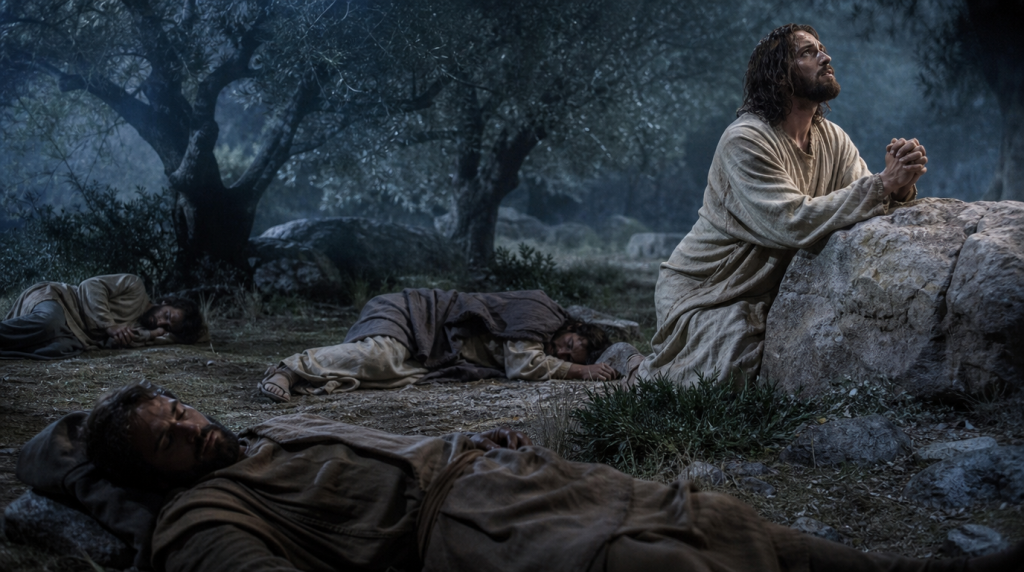
Some of the most powerful prayers are not prayed when life is easy. They are prayed when the heart is heavy, the body is weak, and the future feels overwhelming. That is what we see when Jesus prayed in the garden of Gethsemane.
Matthew 26 tells us that Jesus went with His disciples to Gethsemane before the cross. He told them, “Sit here while I go over there and pray.” Then He took Peter, James, and John with Him and began to be grieved and distressed. He said, “My soul is deeply grieved, to the point of death; remain here and keep watch with Me.”
That shows us something important. Jesus did not pretend sorrow was not real. He did not hide the weight of what was before Him. He faced it honestly before the Father. To pray like Jesus is not to act strong when we are breaking. It is to bring our sorrow honestly to God.
Jesus then fell on His face and prayed, “My Father, if it is possible, let this cup pass from Me; yet not as I will, but as You will.”
That prayer teaches us how to pray when fear, grief, or dread presses hard.
First, Jesus prayed personally. He said, “My Father.” He did not approach God as a stranger. He prayed as the beloved Son speaking to His Father. The saved person can also come to God as Father, not because he is worthy in himself, but because he belongs to Christ.
When we pray, we should remember who we are speaking to. We are not praying to a distant force. We are praying to the living God, our Father, who hears His children.
Second, Jesus prayed honestly. He said, “If it is possible, let this cup pass from Me.” He did not use empty words. He did not pretend the cross was easy. He brought the burden before the Father.
There is nothing wrong with telling God the truth about your pain. You can tell Him when you are afraid. You can tell Him when you are weak. You can tell Him when you do not understand. Honest prayer is not unbelief. It is faith bringing the burden to the only One strong enough to carry it.
Third, Jesus prayed submissively. He said, “yet not as I will, but as You will.” That is the heart of Gethsemane. Jesus made His request, but He surrendered to the Father’s will.
Prayer is not bending God to our wishes. Prayer is bringing our wishes before God and yielding ourselves to His will. Sometimes God removes the cup. Sometimes He gives grace to drink it. Either way, the faithful heart says, “Not my will, but Yours be done.”
That is not easy. The flesh wants control. The heart wants relief. We want God to change the circumstance quickly. But Jesus shows us a better way. We may ask honestly, but we must surrender fully.
Fourth, Jesus continued in prayer. He prayed more than once. He returned and prayed again, saying the same thing. He did not offer one hurried sentence and quit. He stayed before the Father.
Some burdens require repeated prayer. Not because God is hard of hearing, but because our hearts need to keep yielding. Prayer does not always change the situation immediately, but it strengthens the believer to obey God in the situation.
Fifth, Jesus prayed while others slept. The disciples failed to watch with Him. Their spirit was willing, but their flesh was weak. Yet Jesus kept praying.
There may be times when others do not understand your burden. They may fail you, forget you, or grow tired. But the Father never sleeps. When people disappoint you, keep praying. When support is weak, keep praying. When the night feels long, keep praying.
Gethsemane also teaches us that obedience may still be costly after prayer. Jesus rose from prayer and went to the cross. The burden did not vanish, but He walked forward in perfect obedience.
That matters for us. Prayer is not always escape from suffering. Sometimes prayer is preparation for faithfulness. God may not remove every trial, but He will never fail His child.
The greatest comfort in Gethsemane is that Jesus went willingly to the cross. He did not die by accident. He gave Himself for sinners. He bore our sins, paid our debt, and rose again. Because of Him, salvation is by grace through faith, not by works, baptism, church membership, or religious effort.
The One who prayed in Gethsemane is the same Savior who intercedes for His people today. He knows sorrow. He knows suffering. He knows the weight of obedience. When you pray in weakness, you are not praying to One who cannot understand.
So how do we pray like Jesus in Gethsemane?
We come to the Father. We speak honestly. We ask boldly. We surrender fully. We keep praying. We obey even when the path is hard.
When your heart is troubled, do not run from God. Fall before Him. Tell Him the truth. Trust His wisdom. Yield to His will.
The strongest prayer is not always, “Lord, take this away.”
Sometimes the strongest prayer is, “Father, not my will, but Yours be done.”