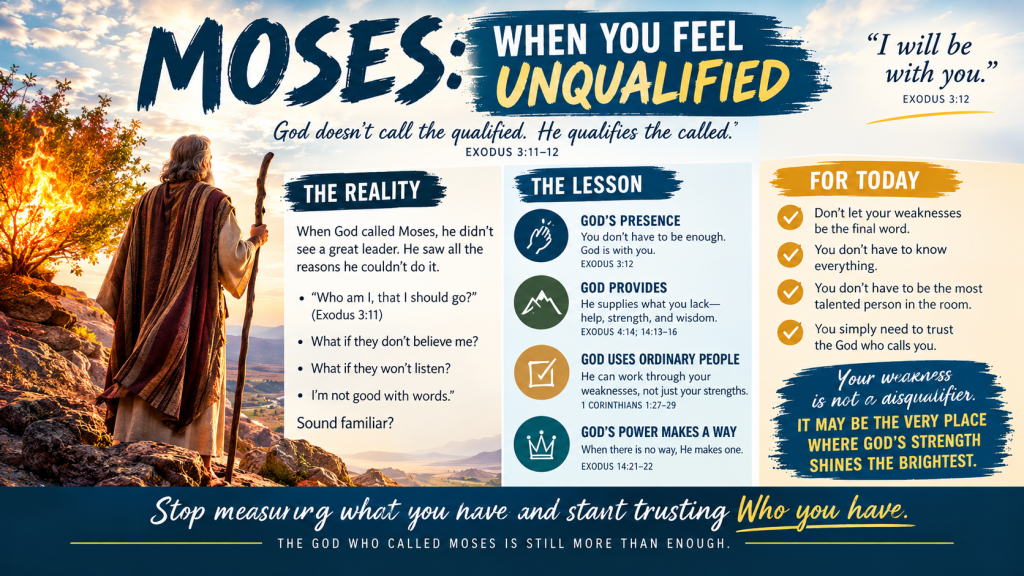
Have you ever looked at something God placed in front of you and thought, “Surely He has the wrong person”?
Moses understood that feeling.
We remember Moses as the man who stood before Pharaoh, led Israel out of Egypt, raised his staff at the Red Sea, and received the commandments from God. But when God first called him, Moses did not see himself as a great leader. He saw all the reasons he could not possibly do what God was asking him to do.
At the burning bush, God told Moses that He had seen the suffering of His people and was going to deliver them from Egypt. Then came the part Moses probably did not expect: God was sending him.
Moses immediately asked, “Who am I, that I should go to Pharaoh?” (Exodus 3:11).Then came more questions. What if they do not believe me? What if they will not listen? I am not good with words. Finally, Moses simply asked God to send someone else.
That sounds surprisingly familiar.
We may never be asked to confront Pharaoh, but we know what it is like to feel inadequate. Maybe you have been given a responsibility at work and wonder whether you are capable of handling it. Perhaps someone at church asks you to serve in an area where you do not feel gifted. Maybe your family needs you to be strong during a difficult season when you do not feel very strong at all.
We compare ourselves to other people and think, “They could do this better than I can.”
They know more.
They speak better.
They have more experience.
They are more confident.
And before long, we have created our own list of reasons God should choose somebody else.
But notice how God answered Moses. He did not give Moses a long speech about how talented Moses really was. He gave him something much better.
He said, “Certainly I will be with you” (Exodus 3:12).That changed everything.
Moses did not need to be enough because God was enough.
God provided what Moses lacked. When Moses worried about speaking, God provided Aaron to help him. When Moses faced Pharaoh, God demonstrated His power. When Israel reached the Red Sea with nowhere to go, God made a way where there was no way.
Moses eventually discovered that the success of God's calling did not depend upon Moses having every qualification. It depended upon Moses trusting the One who called him.
We need to remember that.
God can use education, experience, talent, and ability, but He is not limited by them. Throughout Scripture, God repeatedly used ordinary people who knew they needed Him.
Feeling unqualified does not necessarily mean you are in the wrong place. Sometimes it means you are exactly where you need to be to learn dependence upon God.
You may see weakness. God may see an opportunity for His strength to be displayed.
You may see everything you lack. God knows everything He can provide.
You may be asking, “Who am I?”
Perhaps the better question is, “Who is going with me?”
Moses' confidence was never supposed to rest in Moses. Neither is ours.
So when God places an opportunity, responsibility, or act of obedience before you, do not allow your weaknesses to have the final word.
You do not have to know everything.
You do not have to be the most talented person in the room.
You do not even have to feel qualified.
You simply need to trust the God who says, “I will be with you.”
Your weakness does not disqualify you from being used by God. It may be the very place where His strength becomes most visible.
When God calls, stop measuring what you have and start trusting Who you have.
Because the God who called Moses is still more than enough.