Thomas is often remembered by one word: doubter. But that label does not tell the whole story. Thomas struggled, yes. He questioned. He wanted proof. But he was not careless, shallow, or indifferent. He was a man whose faith had been wounded by grief.
When Jesus was crucified, Thomas did not merely lose a teacher. He lost the One he believed was the Christ. His hopes were crushed. His heart was shaken. So when the other disciples said, “We have seen the Lord,” Thomas could not bring himself to believe it.
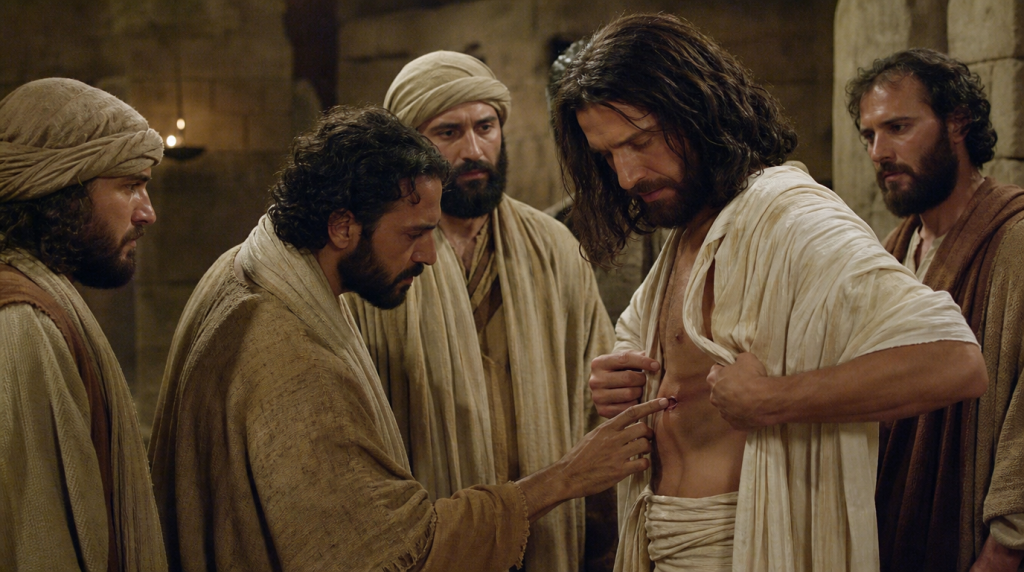
He said, “Unless I see in His hands the imprint of the nails, and put my finger into the place of the nails, and put my hand into His side, I will not believe.”
Those were not the words of a man playing games with truth. They were the words of a broken man who could not bear to hope and be disappointed again.
But Jesus did not abandon Thomas in his struggle.
Eight days later, Jesus came and stood among the disciples. Thomas was there. The Lord turned directly to him and said, “Reach here with your finger, and see My hands; and reach here your hand and put it into My side; and do not be unbelieving, but believing.”
Jesus knew exactly what Thomas had said. He knew the doubts. He knew the demand. He knew the weakness. Yet He came to restore him, not destroy him.
Thomas answered with one of the strongest confessions in the New Testament: “My Lord and my God!”
That is why Thomas should not be remembered only for doubt. His doubt was real, but so was his confession. He moved from hesitation to worship, from uncertainty to surrender, from wounded faith to clear testimony.
There is a warning here. Doubt should not be nursed, defended, or treated as harmless. Unbelief is serious. Jesus told Thomas, “Do not be unbelieving, but believing.” The Lord does not flatter doubt. He calls us out of it.
But there is also mercy here. Christ is patient with weak believers. He does not cast away His own because their faith trembles. He brings them back to truth.
Many Christians have had moments like Thomas. They have wondered why God allowed pain. They have struggled after disappointment. They have heard others rejoice while their own hearts felt numb. But the answer is not to walk away. The answer is to stay near the people of God, listen to the Word of God, and look again to the risen Christ.
Thomas was absent when Jesus first appeared to the disciples. But the next time, he was present. That matters. Sometimes restoration begins by being where you ought to be, even when your heart is struggling.
The risen Christ was the answer Thomas needed. Not emotion. Not rumor. Not secondhand excitement. Christ Himself.
Thomas teaches us that wounded faith can be healed. Doubt can be answered. Weakness can become worship.
He was more than a doubter.
He was a disciple who saw the risen Lord and confessed the truth clearly:
“My Lord and my God!”